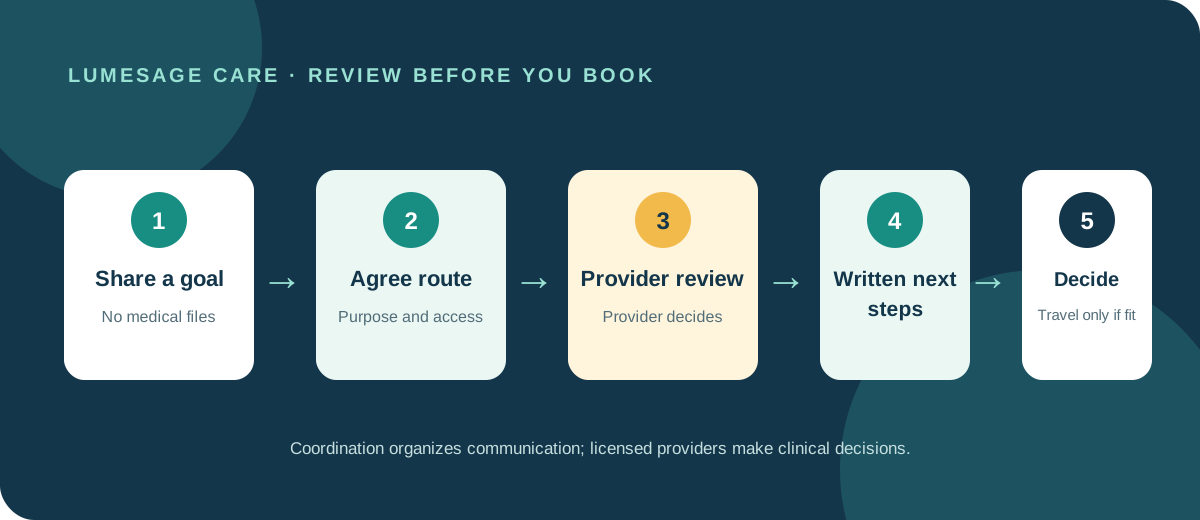
Step 1: State your planning goal without sending a medical file
For an initial inquiry, share only basic contact details, country, preferred city and the type of coordination information you need. Avoid diagnoses, symptoms, medications, test results, scans, passport details and patient identifiers in a public form. The first exchange should establish whether there is a reasonable administrative path to a provider review.
Step 2: Confirm who will review the case
Before sending records, ask for the name of the receiving hospital or provider, the relevant department, the purpose of the review, the expected review process and whether there is a fee. Ask whether the review is performed by a clinician or by an administrative coordinator. A coordinator may help organize files or arrange translation, but that does not make the coordinator a clinical reviewer.
Step 3: Agree on the records channel and handling
Use a separate secure transfer method only after the provider or coordinator explains it. Ask who will have access, where the records will be stored, whether they will be sent to another organization, how long copies are kept, and how you can request correction or deletion. Confirm that you are permitted to share the records and that the person whose records they are has authorized the transfer. Send only what is required for the stated review.
Do not send sensitive medical information through ordinary email or a general website form unless the responsible provider has explicitly told you that channel is appropriate and explained the risks.
Step 4: Request a written provider response
Ask the provider to distinguish what is known from what requires an examination. A useful preliminary response may identify the department, whether an appointment is possible, what additional evaluation may be needed, an estimated schedule and a preliminary cost range. It should also explain the limits: an estimate can change after examination, and an initial review does not guarantee admission, treatment or a particular outcome.
Step 5: Decide whether travel is still worthwhile
Compare the provider response with your needs at home. Consider urgency, travel time, accessibility, language, insurance, total costs, local follow-up and what you would do if the provider changes its recommendation. Ask your current clinician what continuity information you should plan to bring back. Do not delay urgent or time-sensitive care while waiting for an overseas response.
Step 6: Confirm roles and terms before booking
Before paying for coordination or travel, obtain the written service scope, provider charges, coordination charges, cancellation rules, refund terms and any commercial relationships. Confirm who arranges appointments, interpretation, transport and records delivery. These roles should be clear enough that the patient knows whom to contact if a schedule changes.
Step 7: Plan the return-home handoff
Ask what documents the hospital expects to provide, the language and format, how imaging will be made available, and whether the patient can authorize transfer to a U.S. clinician. Confirm that any clinical follow-up remains with a licensed provider. A coordinator can help pass along documents or schedule a conversation, but cannot replace a U.S. care team or guarantee that a local insurer or clinician will accept a particular plan.
For current travel, payment and insurance considerations, consult the U.S. Department of State China guidance and your insurer. For travel health coverage considerations, review the CDC Yellow Book.
Sources and further reading
- U.S. Department of State: China Travel Advisory (accessed November 4, 2026)
- CDC Yellow Book: Travel Insurance, Travel Health Insurance, and Medical Evacuation Insurance (accessed November 4, 2026)
Guidance and coverage can change. Confirm current details with the relevant government agency, insurer and healthcare provider.