Compare like with like
A price on a website may refer to one service, a broad package or an initial estimate. It may exclude consultation, tests, medication, additional procedures, interpretation, accommodation or follow-up. Before comparing an overseas quote with a U.S. bill, make sure the scope, provider, dates, services and exclusions match.
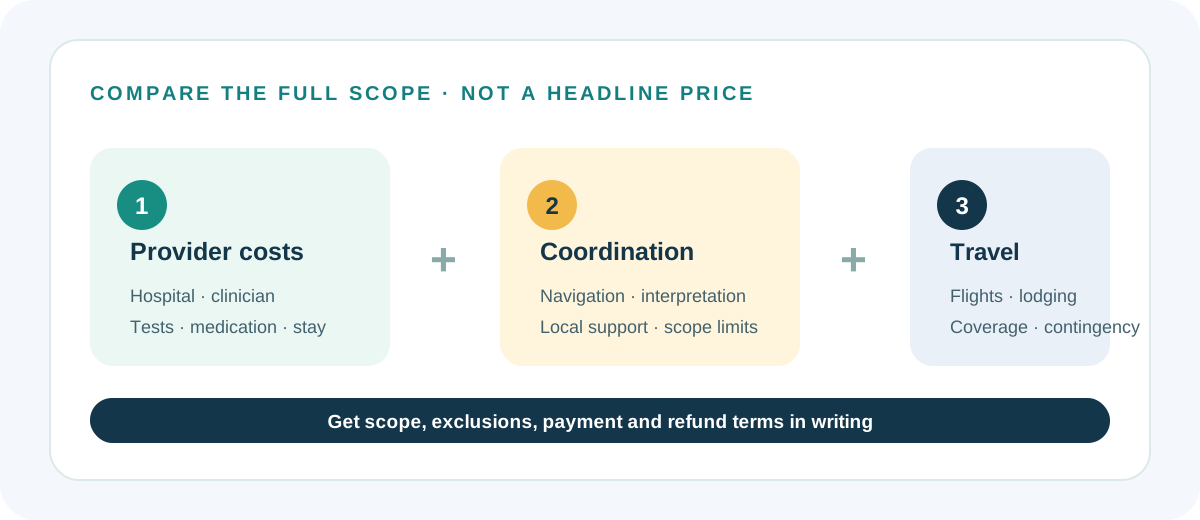
Ask for three separate budgets:
- Provider costs: consultation, tests, procedure or treatment, hospital stay, medication and possible additional evaluation.
- Coordination costs: navigation, appointment support, interpretation, local transport or other services, with inclusions and limits.
- Travel costs: flights, accommodation, meals, local travel, companion expenses, insurance and contingency funds.
Ask the hospital for a written estimate
Confirm who prepared the estimate and whether a clinician reviewed the information. Ask what assumptions it uses, how long it remains valid, what can change the amount after an in-person examination, whether a deposit is required, and how payment and refunds work. Ask whether the estimate is in U.S. dollars or another currency and who bears exchange-rate or card fees.
The U.S. Department of State states that medical care in China is not free and that hospitals may require payment before service or admission. This makes direct verification of payment channels, receipts, deposits and emergency arrangements particularly important. Never assume that a public hospital visit is free to an international patient.
Verify insurance instead of assuming reimbursement
Call the insurer using the number on your member card and ask about planned care outside the United States. Request answers in writing when possible. Ask whether the service is covered, whether prior authorization is required, what documentation is needed, how claims are submitted, whether a translated itemized bill is required, and whether post-treatment complications or follow-up in the United States are covered.
Medicare says it usually does not cover healthcare while traveling outside the U.S., although exceptions exist. Medicare Advantage, Medigap and employer or private plans may have different terms. Check your exact plan. A travel policy may cover trip interruption or emergency assistance without covering planned treatment. Read exclusions and pre-existing-condition rules carefully.
Build a realistic total-cost worksheet
- Provider estimate and what is excluded
- Coordination quote and named deliverables
- Flights, hotel, meals and local transport
- Insurance premium, deductible and reimbursement conditions
- Possible additional tests, extra nights and a companion
- Cancellation, rescheduling, refund and exchange-rate costs
- Return-home appointments and local follow-up expenses
Use a contingency line rather than treating an estimate as a guaranteed total. Do not make a decision based only on a headline percentage of savings. A fair comparison includes the full service scope, clinical suitability, travel burden, coverage uncertainty and follow-up needs.
Questions to ask before any payment
- Who receives each payment: the hospital, the coordinator, the travel supplier or another party?
- Which services are included and which are billed separately?
- What happens if a provider declines the request or changes the plan?
- What cancellation and refund terms apply at each stage?
- Will I receive an itemized invoice and a receipt?
- Is there any referral, commission or other commercial relationship that should be disclosed?
Official references: State Department China guidance and Medicare travel coverage. These sources are general information; your insurer and provider determine your specific terms.
Sources and further reading
- U.S. Department of State: China Travel Advisory (accessed November 4, 2026)
- Medicare: Travel outside the U.S. (accessed November 4, 2026)
Guidance and coverage can change. Confirm current details with the relevant government agency, insurer and healthcare provider.