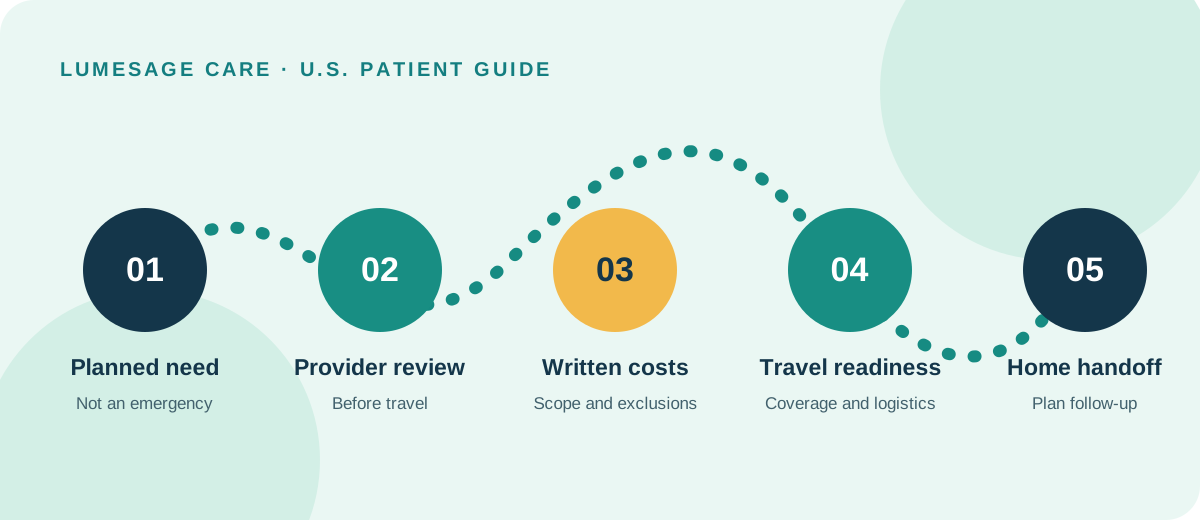
Start by asking whether travel is appropriate
Cross-border care may be a poor fit when a need is urgent, when the treatment requires frequent in-person monitoring, or when you cannot arrange follow-up after returning home. Do not delay local medical care while seeking an overseas appointment. For a planned assessment, first ask your current clinician which records or questions would help you compare options.
A coordinator can help organize a conversation with a hospital. Only the receiving hospital or its licensed clinicians can decide whether it can review your case, what evaluation is needed, and whether an in-person visit is appropriate.
Get the provider review before planning the trip
Before booking flights, ask who will review the inquiry, what information is needed, whether a remote consultation is available, how long the review may take, and what a written preliminary plan can and cannot confirm. A preliminary estimate is not a final diagnosis, treatment plan, or guarantee that the same services will be offered after examination.
- Confirm the hospital and department that will handle the request.
- Ask whether the clinician has reviewed the relevant records or is responding only to a short summary.
- Get the proposed appointment sequence and expected time in writing.
- Ask what could change the plan after arrival and what would happen if the provider recommends a different approach.
Separate hospital charges from coordination and travel costs
Request an itemized written estimate. Identify hospital and clinician charges separately from navigation, interpretation, transportation, accommodation and other travel costs. Ask which tests or services are included, which are optional, what could cause the price to change, the payment currency, deposit amount, payment method, receipts, cancellation rules and refund conditions.
The U.S. Department of State notes that medical care in China is not free and that providers may require payment or a deposit before care. Verify payment details directly with the receiving provider and do not rely on an informal chat message as the final quote.
Check insurance and travel protection yourself
Contact your health insurer and request written guidance about planned care abroad, claims, exclusions, preauthorization and follow-up at home. Medicare generally has limited coverage outside the United States, with defined exceptions; do not assume it will reimburse a planned overseas service. Travel insurance, travel medical insurance and medical evacuation insurance are different products. Read the policy conditions and confirm whether planned treatment, pre-existing conditions, complications and evacuation are covered.
Useful official starting points: Medicare coverage outside the U.S., U.S. Department of State China travel guidance, and the CDC Yellow Book chapter on travel insurance.
Agree on a safe records process
Do not place diagnoses, medical records, passport numbers or identifiable health information in a general website inquiry form or public community. Before sending records, ask who will receive them, why they are needed, how they will be transferred, who can access them, how long they will be retained and whether they will be shared with a provider. Use only the agreed secure route and share the minimum information needed for the provider review.
Plan language, travel and the return home
Confirm whether interpretation is available for the specific appointment, who will provide it and what it does not include. Check current entry and travel requirements through official government sources; rules can change. Confirm the hospital's payment methods, local transport, accessibility needs, medication requirements and emergency plan.
Before you leave, ask how you will receive the visit summary, test results, imaging and medication information in a form you can share with your U.S. clinician. Confirm who will answer administrative questions after you return and who is responsible for clinical follow-up. Coordination can help organize a handoff, but it does not replace ongoing care from your local clinicians.
Pause if the basics are missing
- No identifiable provider or department is willing to review the request.
- You are pressured to pay or travel before receiving written scope and terms.
- The marketing promises a diagnosis, cure, guaranteed appointment or fixed outcome.
- You cannot get a clear breakdown of hospital fees and coordination fees.
- No one can explain records handling or return-home follow-up.
A careful “not yet” can be the right decision. The goal of planning is to make an informed choice—including the choice to remain in local care.
Sources and further reading
- U.S. Department of State: China Travel Advisory (accessed November 4, 2026)
- Medicare: Travel outside the U.S. (accessed November 4, 2026)
- CDC Yellow Book: Travel Insurance, Travel Health Insurance, and Medical Evacuation Insurance (accessed November 4, 2026)
Guidance and coverage can change. Confirm current details with the relevant government agency, insurer and healthcare provider.